
How Government Can Break Nigeria's Rent Spiral: A Practical Housing Agenda
Rent rises because homes are scarce, not because landlords are unkind. What happens when a state builds at least three estates of 1,000 homes for its own public servants, as in Ondo or Osun, and what else governments can do to bring rents down.
Every year the pattern repeats. Rent rises, usually without warning and usually by more than anyone's pay has moved. Tenants absorb it, or move further from work, or share a flat they once had to themselves. Public servants, whose salaries are fixed by the government and sometimes paid late, feel it most. The usual public response is a call on landlords to show compassion, or a loud argument about rent control. Neither changes much, because a rent increase is a price, and prices climb when demand outruns supply.
If that is the diagnosis, the cure is not persuasion. It is supply, and in particular supply that ordinary earners can afford. What follows is a practical look at what state governments can do, starting with a question worth asking: what happens to rents when a state builds homes for its own workers?
Why the familiar responses fall short
Appeals to landlords' goodwill ignore the incentives. A landlord who can find a tenant at a higher price will usually take it, and in a market where good homes are scarce, one is easy to find.
Blunt rent caps carry a different risk. Where they are imposed without new housing, the usual outcome is fewer rental listings, quieter deals made off the record, and less money spent on maintenance. Tenants who already have a home may benefit; those still looking find the door shut. A policy meant to protect renters can end up locking them out.
The more reliable approach is to change the balance between homes and households, and to make the cost of owning or renting a decent home more predictable. That is slower than a decree, but it works with the market rather than against it.
What happens when a state builds for its own workers
Picture a state government that decides to build. Not a single showpiece estate, but at least three, each of around 1,000 homes, in different parts of the state, sold or let at deeply discounted prices to public and civil servants. It is worth thinking through what that does, because in cases where states have the land and the will to do it, the effect on rents can be real.
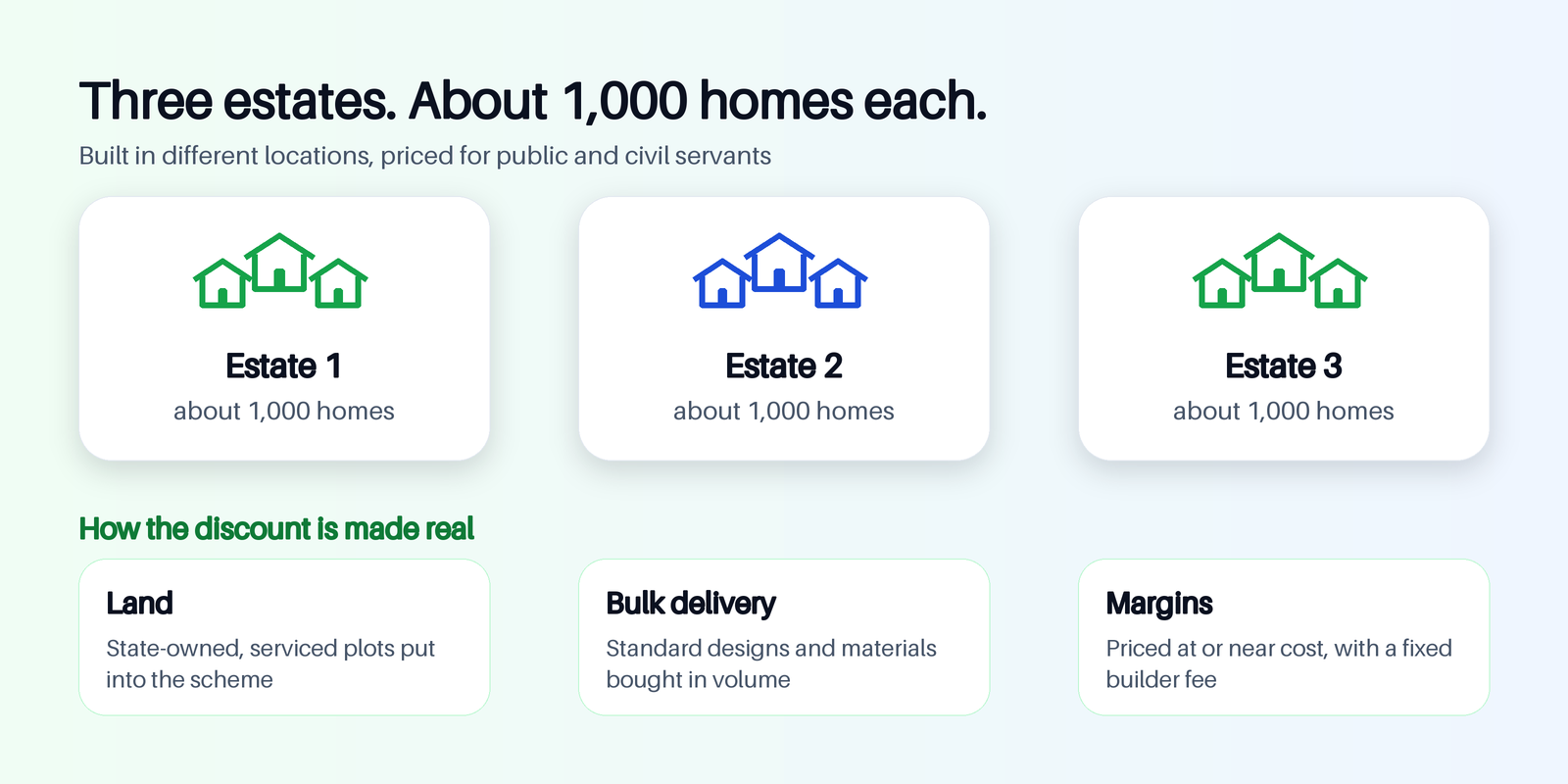
An illustration of the scale discussed: three estates of about 1,000 homes each, in different locations.
It matters most in states where the civil service is the biggest employer. Ondo and Osun are the obvious examples, but the same logic holds anywhere that government payroll drives a large share of local demand for housing. In those places, public servants are not a small group competing for a few flats. They are a large part of the renting population, so moving even a few thousand of them into homes of their own is felt across the whole market.
How a discount can be real
A discount only lasts if costs come down, and a state controls several of the heaviest cost items.
- Land. The state already holds land. Putting serviced plots into the scheme removes one of the biggest charges from any development.
- Bulk delivery. A thousand homes built to a handful of standard designs, with materials bought in volume, cost less each than the same homes built one at a time.
- Margins. Prices set at or near cost, with a fixed fee for the builder rather than a market profit, are what turn "affordable" from a label into a number.
Payment can be a rent-to-own arrangement over a long term, with instalments at or below what a comparable flat costs to rent today, deducted from salary at source. That keeps the risk low for the state and for the buyer.
What decides whether it works
Housing schemes in many countries have come unstuck not for lack of buildings but because of how they were allocated and managed. A few rules make the difference.
- Finish before allocating. Homes should be complete, with roads, water and power connected, before anyone is asked to pay. Estates left half built, or built without services, are the commonest failure.
- Allocate in the open. A public portal, clear eligibility rules and a transparent ballot protect the scheme from favouritism and from middlemen.
- Stop the discount leaking. If buyers can resell or sublet at once, the benefit goes to whoever flips the property. A minimum holding period, and a limit of one home per household, keep it with the people it was meant for.
- Plan the upkeep. A service charge and an estate management body from the first day prevent the slow decline that undermines many public estates.
What it does to rents
Where a state delivers estates on this scale, three things tend to follow, and none of them needs a confrontation with landlords.
First, every civil servant who buys leaves the rental pool, which eases competition for the flats that remain. Second, the flat they leave goes back on the market. Third, and perhaps most important, the estates create a visible benchmark. When a household can see that a decent two-bedroom home can be owned for a monthly payment of a known size, a landlord asking far more has to offer something better in return: a better location, finish or service. In chess terms it is a quiet check on rents, not by forcing anyone's hand but by taking away the scarcity that lets prices climb unchallenged.
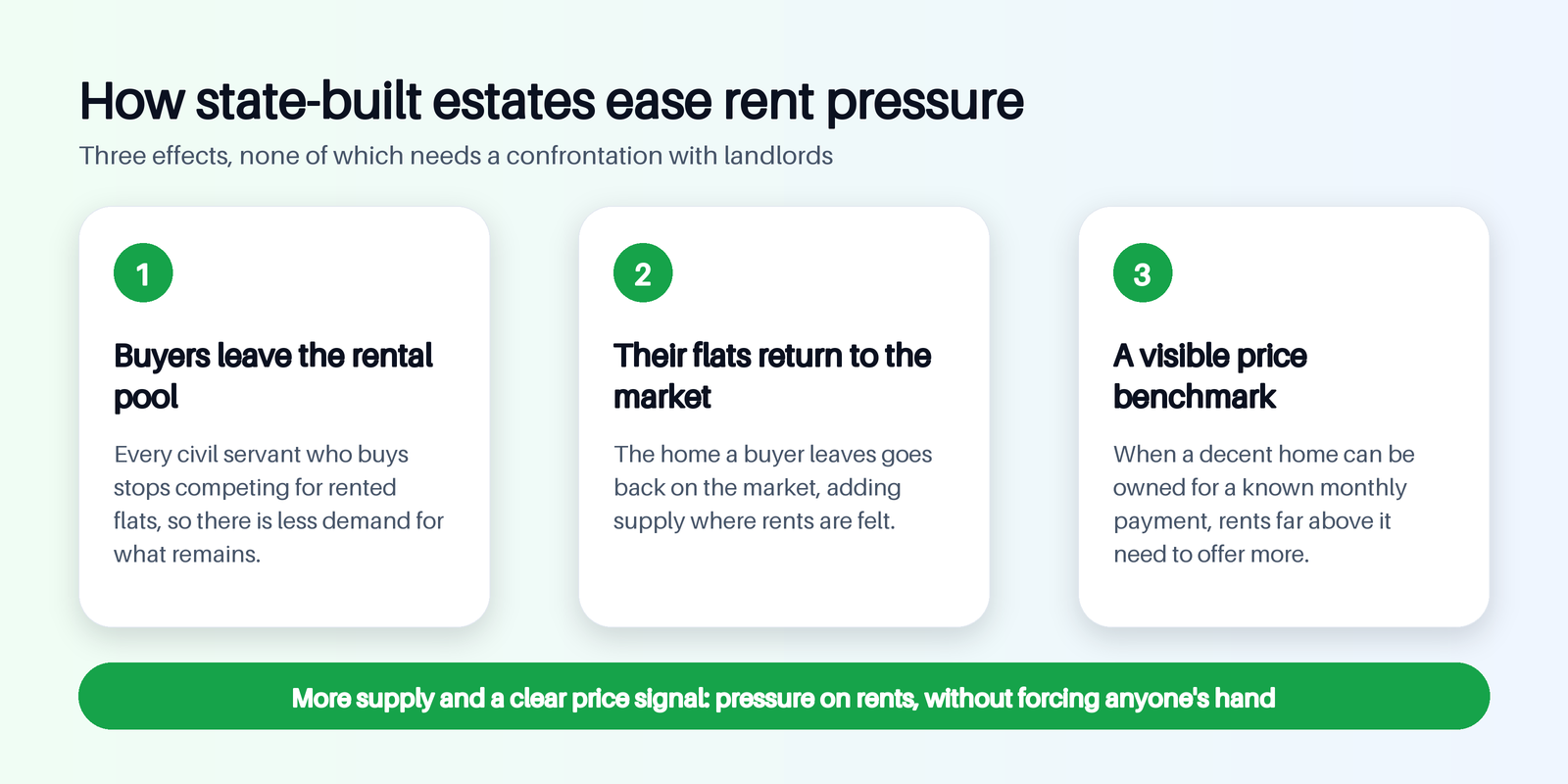
How state-built estates put pressure on rents.
It would be wrong to oversell it. Three estates of a thousand homes will not end a shortage measured in millions of units, and the effect will be strongest in smaller cities where government is the main employer. The case for it is that it is concrete, visible and repeatable, and each round adds to supply and to the pressure on prices.
Other measures that make a difference
Estates are one tool. A sustained fall in rent pressure needs several working together.
Make mortgages usable by ordinary earners
Formal mortgage finance reaches very few Nigerians. The National Housing Fund, to which many workers already contribute 2.5 per cent of their monthly income, and the Federal Mortgage Bank of Nigeria were designed to change that, yet many contributors report long waits and complicated processes. Faster approvals, longer repayment terms, state-backed guarantees and partnerships that let employers pay housing allowances towards a mortgage rather than into rent would widen access considerably.
Clear the land and title bottleneck
Building cannot start without clear title, and obtaining it can take months or years. Digitising land registries, setting firm deadlines for issuing and registering titles, and releasing idle public land as serviced plots would shorten the path from idea to construction, and lower the risk that lenders and builders have to price in.
Lower the cost of building
Approvals that take a long time or involve many offices add cost to every project. A one-stop permit process with published timelines, standard approved designs for modest homes, and relief on the levies that fall on building materials would reduce what it costs to supply a home. So would greater use of locally produced materials and standard designs.
Open up new areas with infrastructure
A major driver of rent in any city is the scarcity of well-connected land. Roads, water and power extended to new corridors make cheaper land usable and draw demand away from congested centres. Infrastructure is, in effect, a housing policy.
Change how rent is paid and how tenancies are governed
Many landlords still ask for a year's rent upfront, which is a barrier in itself. Encouraging monthly or quarterly payment, supported by rent-financing partnerships and deposit schemes, would lower the cash needed to move. Some states have tenancy laws that limit advance rent and require notice before eviction, but enforcement is uneven; consistent enforcement, standard written agreements and a fast, affordable way to settle disputes would help both tenants and honest landlords. Readers who want to know what a fair agreement looks like can start with what to check before signing, and with what the upfront costs of renting usually include.
Encourage private builders to supply rental homes
Government cannot, and should not, build everything. Tax relief for new rental housing, public-private partnerships on public land and a simpler set of levies would give private developers a reason to build for rent, not only for sale at the top of the market.
Publish the data
Policy is easier to design, and easier to judge, when rents and prices are visible. Area-level figures on what homes are advertised for and how long they stay available, drawn from registries, agents and listing platforms, would let governments see where pressure is building and whether a measure is working.
A sequence that makes sense
The reforms to land, finance and approvals take time to show results. Estates can be seen within a few years, and they give the longer reforms something to work alongside. For a state willing to try, a sensible order is to start with a small number of sites, publish the allocation rules and prices before the first brick is laid, and measure the outcome in terms that matter to tenants: how much of household income goes on rent, how long a decent home takes to find, and how many people on the waiting list have been housed.
Rent rises will not be solved by a speech or a cap. They will ease when there are more homes, within reach of the people who need them, and when the process of getting one is clear enough to trust. For states that can build, their own workers are a good place to start.
If you are renting now, browse current listings on 9jaFinder to compare what homes are advertised for in your area before you commit.


Comments
Questions and corrections welcome. Be kind; links are limited to keep spam out.