
Proptech in Nigeria: How Technology Is Changing the Way Homes Are Found, Paid For and Managed
Property is one of Nigeria's biggest and most analogue industries. From search on WhatsApp to monthly rent payments, verified profiles and digital records, here is where proptech is making a real difference, and what still stands in the way.
Few industries in Nigeria are as large, as old or as stubbornly analogue as property. Homes are found through word of mouth, priced by negotiation, verified by instinct and paid for in a single lump sum. Records are kept on paper, if they are kept at all, and the person standing between a renter and a front door is often someone neither side can easily check.
Property technology, or proptech, is the attempt to change that. The label covers a wide range of ideas, from listing platforms to rent payments to construction methods. What makes the Nigerian version worth watching is that it is not a copy of what has worked elsewhere. It is being shaped by local frictions: unreliable information, thin trust, upfront payments that are large compared with incomes, and a population that reaches the internet mainly through a phone. The most interesting innovations are the ones built around those realities.
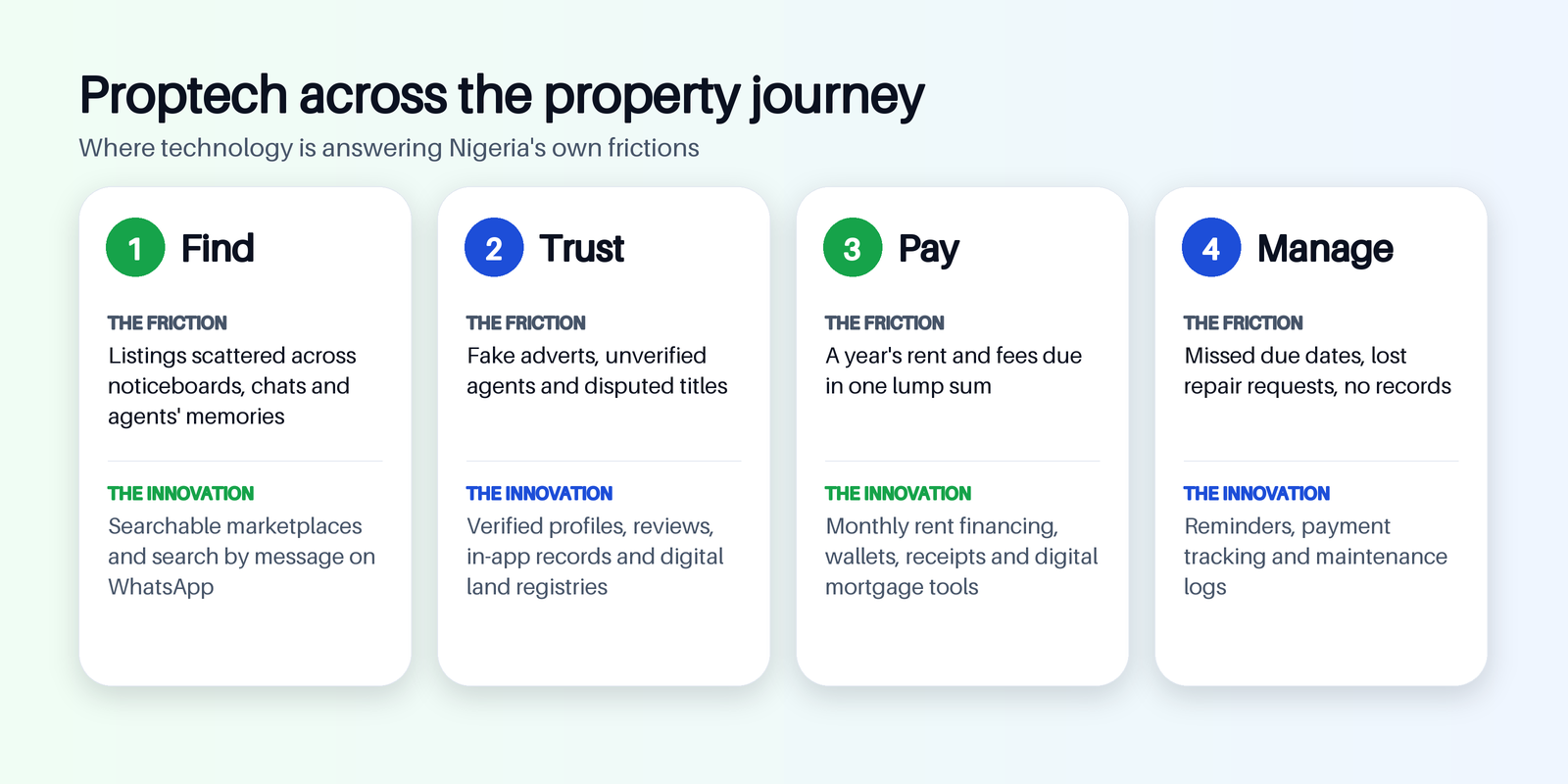
Where technology is answering Nigeria's own frictions, from finding a home to managing it.
Finding: from word of mouth to a single message
The first and most visible change is in how people look for property. Online marketplaces have moved listings out of noticeboards, group chats and agents' memories into places where a renter can search by area, price and type, compare options and see photographs before travelling anywhere. For a city where a viewing can cost half a day in traffic, that alone saves real time and money.
The next step is meeting people where they already are. Most Nigerians spend their online time in a messaging app, not in a property portal, and asking them to install and learn one more app is a considerable ask. Some platforms are therefore moving the search into the chat itself. 9jaFinder, for example, has extended its property search to WhatsApp, so that a renter can describe what they want in a sentence, including budgets written the Nigerian way, such as 3m or 500k, and receive matching listings in reply. The technology involved is not exotic. The innovation is in the distribution: the product goes to the user rather than the other way round.
Trust: the real product
Technology can make listings easy to find, but a renter's real worry is whether a listing is real. Fake adverts, agents with no authority to let a property and disputed ownership are the problems that cost people the most, and any proptech business that does not address them is solving the wrong problem. Our own guide to spotting rental scams exists because the risk is common.
Several kinds of innovation are aimed at this. Verified profiles for agents and landlords, together with reviews from earlier tenants, give a new renter something to check. Calling, messaging and inspection bookings that happen inside a platform leave a record that a phone call does not. Photographs and location pins tied to a listing make it harder to advertise a home that does not exist. Further upstream, some state governments have been digitising their land registries, which, as it spreads, will make title searches faster and more reliable. Electronic agreements and receipts do a quieter but equally useful job: they create the paper trail that both tenant and landlord are glad of when there is a dispute.
None of these tools makes inspection unnecessary. They shift the odds, and that is what trust amounts to.
Paying: breaking the lump sum
A large share of the difficulty of renting in Nigeria is financial rather than informational. Many landlords ask for a year's rent in advance, together with agent and legal fees and a deposit, and few households can produce that sum at once. Proptech has started to respond in several ways. Rent-financing services allow a tenant to pay monthly while the landlord is paid in full upfront. In-app wallets let tenants pay and keep a receipt, and let landlords see what has been received without a trip to the bank. On the ownership side, digital mortgage tools aim to shorten the approval process, and fractional investing platforms, which fall under securities regulation, let people put smaller sums into property than a whole-home purchase would require.
The common thread is that the technology does not make housing cheaper. It makes the payment schedule fit the way people are paid, which is often what stands between a household and a home.
Managing: the unglamorous work
Much of the value in property is created after the keys change hands, and much of the friction as well. Rent due dates are forgotten. Maintenance requests are made by phone and lost. Landlords with several units lose track of who has paid. Software that sends reminders, tracks payments, records repair requests and generates receipts addresses those problems directly. 9jaFinder's managed service, for example, includes automated rent reminders, wallet-based collection and maintenance tracking, and our guide for landlords describes the habits that make the difference. It is dull work, but it is where goodwill between tenant and landlord is most often lost or kept.
Building and powering homes
Not all proptech lives on a screen. Construction technology is trying to lower the cost and time of building, through standard designs, prefabricated and modular components, and online marketplaces for materials that give builders clearer prices. Energy is another quiet area of innovation. Anyone who has inspected a property in Nigeria knows that the first questions are about power and water, and homes that are solar-ready or served by reliable prepaid metering are increasingly advertised as such. The more clearly listings state what a property offers in these respects, the easier it is for a renter to compare like with like.
Data: seeing the market
A market is easier to fix when it can be seen. Historically, Nigeria has had little public, consistent information on what homes cost to rent or buy in a given area. Platforms hold part of the answer, because every listing records a location, a type and a price. Aggregated and anonymised, that information can show where rents are rising, how long homes stay available and which areas are being overlooked. It is the kind of evidence that policymakers need, as we argued in a piece on what governments can do about rising rents, and that renters need before they negotiate.
What still stands in the way
It would be wrong to present technology as a cure. Data is expensive and connectivity uneven, and a tool that works on a fast connection in a major city may be slow or unusable elsewhere. Much of the market remains informal: cash payments, unwritten agreements and unregistered tenancies leave little for software to work with. Rules on rent financing, investment platforms and data protection are still developing, and firms must keep pace with them. The quality of what platforms offer depends on the quality of what is listed, and a search is only as good as the inventory behind it.
Above all, technology does not build homes. A better search does not help if the right homes do not exist at the right price, which is why proptech is a complement to housing policy and not a substitute for it.
What to watch
The direction of travel is reasonably clear. Search is becoming conversational and moving into the apps people already use. Verification is becoming a standard expectation instead of a premium feature. Payment options are being redesigned around monthly incomes. And the records created by all of this, from listings to receipts to registries, are slowly building the data that the sector has long lacked.
For renters, buyers, landlords and agents, the practical advice is simple. Use the tools that save time, and be wary of any that ask for money before you have seen a property. If you are looking now, you can browse the current listings on 9jaFinder and compare what is on offer in your area.


Comments
Questions and corrections welcome. Be kind; links are limited to keep spam out.